
Enter password to view case study

Low-code platform powered by spreadsheets
In 2021, I led design at Lido, an early-stage startup based in New York. When I joined, the team was pre-market fit and had just launched an early MVP.
During my time there, I wore many hats. I developed the product vision with the founder, explored market-fit opportunities, and built a design system with engineering — while also running usability studies and helping develop the marketing site in Webflow.
Company
Lido
Role
Lead designer
Year
2021

Low-code platform powered by spreadsheets
In 2021, I led design at Lido, an early-stage startup based in New York. When I joined, the team was pre-market fit and had just launched an early MVP.
During my time there, I wore many hats. I developed the product vision with the founder, explored market-fit opportunities, and built a design system with engineering — while also running usability studies and helping develop the marketing site in Webflow.
Company
Lido
Role
Lead designer
Year
2021

Low-code platform powered by spreadsheets
Cubby is a self-storage management platform that's modernizing a $50B industry. I led the 0→1 design of Cubby’s Revenue Suite with a cross-functional team of engineers and product managers.
Company
Lido
Role
Lead designer
Year
2021


The problem
The problem
The problem
Teams create and store their data across a range of disconnected tools, making it hard to connect that data or put it to work in automated workflows.



The vision
Spreadsheets are central to how teams work. They are a foundational part of office work culture. Lido’s early vision was to build off of this fact and operate as a low-code app builder that leverages spreadsheets, familiar scripts, and connected data to power DIY applications and automated workflows.
The vision
Spreadsheets are central to how teams work. They are a foundational part of office work culture. Lido’s early vision was to build off of this fact and operate as a low-code app builder that leverages spreadsheets, familiar scripts, and connected data to power DIY applications and automated workflows.
The vision
Spreadsheets are central to how teams work. They are a foundational part of office work culture. Lido’s early vision was to build off of this fact and operate as a low-code app builder that leverages spreadsheets, familiar scripts, and connected data to power DIY applications and automated workflows.
💡 Note: The product vision evolved during my time there and has changed since I left. The following work highlights our explorations; some launched, others were pushed off till later, and others were abandoned or de-prioritized cause of timing, constraints, or because they weren’t the right fit.

Connect & shape data
Connect data from other apps into Lido, join, and pivot data to help with analysis, and then leverage data in the dashboard, or use in automations.
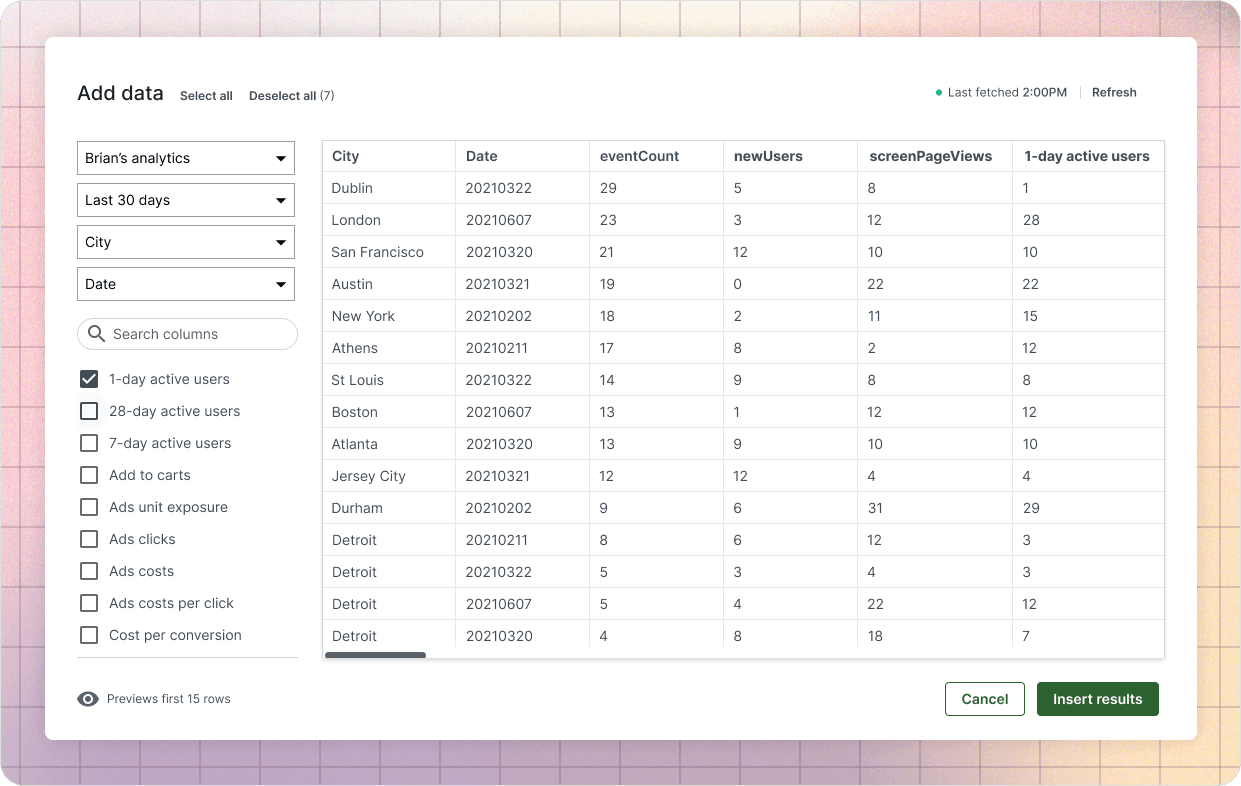
Connect external data, then select columns to add
Select data columns to add to table. Preview to confirm structure and work with data load constraints before adding to document.

Connect external data, then select columns to add
Select data columns to add to table. Preview to confirm structure and work with data load constraints before adding to document.

Connect external data, then select columns to add
Select data columns to add to table. Preview to confirm structure and work with data load constraints before adding to document.

Quickly pull in meaningful API data
Explorations that never launched
We wanted to help people quickly ingest public data that could then be used to power specific analytical use cases. In this illustration, we explored the idea of creating an App Store for APIs within Lido. Each API would be labeled based on a core task it would perform and would include simple parameters to pull from either a spreadsheet or an input field.

Quickly pull in meaningful API data
Explorations that never launched
We wanted to help people quickly ingest public data that could then be used to power specific analytical use cases. In this illustration, we explored the idea of creating an App Store for APIs within Lido. Each API would be labeled based on a core task it would perform and would include simple parameters to pull from either a spreadsheet or an input field.

Quickly pull in meaningful API data
Explorations that never launched
We wanted to help people quickly ingest public data that could then be used to power specific analytical use cases. In this illustration, we explored the idea of creating an App Store for APIs within Lido. Each API would be labeled based on a core task it would perform and would include simple parameters to pull from either a spreadsheet or an input field.
Learnings from connecting & shaping data
It’s difficult to distinguish externally connected data from data created in the spreadsheet. This creates conceptual and usability hurdles.
There’s a limit to the amount of data that browsers can handle. This requires transparency and prompts to encourage users to create narrower queries.
Early engineering decisions made in a race to get an MVP up made it challenging being agile later on.
Learnings from connecting & shaping data
It’s difficult to distinguish externally connected data from data created in the spreadsheet. This creates conceptual and usability hurdles.
There’s a limit to the amount of data that browsers can handle. This requires transparency and prompts to encourage users to create narrower queries.
Early engineering decisions made in a race to get an MVP up made it challenging being agile later on.
Learnings from connecting & shaping data
It’s difficult to distinguish externally connected data from data created in the spreadsheet. This creates conceptual and usability hurdles.
There’s a limit to the amount of data that browsers can handle. This requires transparency and prompts to encourage users to create narrower queries.
Early engineering decisions made in a race to get an MVP up made it challenging being agile later on.

Write scripts & trigger actions
We designed the experience to tap into the deep well of knowledge users bring to spreadsheet software like Sheets and Excel. We use that level of familiarity and comfort as a catalyst to inspire more advanced and new application and automation-building experiences.
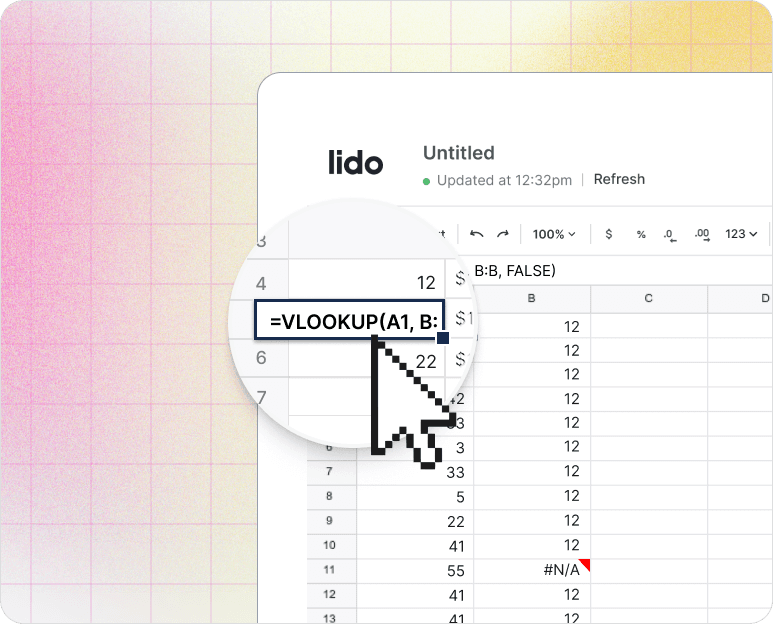
Leverage familiar scripting languages from Excel and Sheets
Familiar methods to write scripts in-cell and in the script bar. Also, ways to bind input fields in the dashboards to ranges or cells in the spreadsheet.
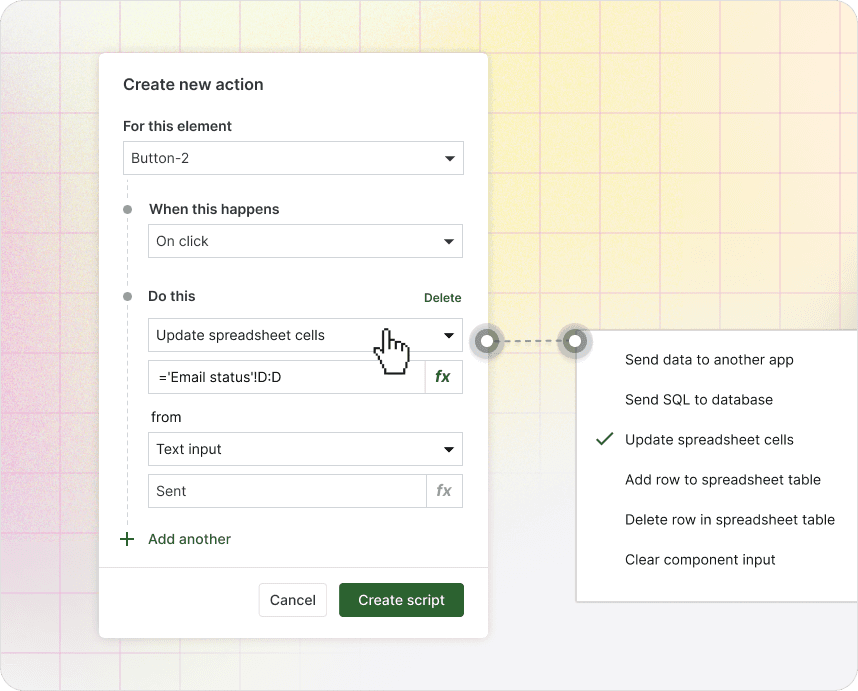
Leverage familiar scripting languages from Excel and Sheets
Familiar methods to write scripts in-cell and in the script bar. Also, ways to bind input fields in the dashboards to ranges or cells in the spreadsheet.

Leverage familiar scripting languages from Excel and Sheets
Familiar methods to write scripts in-cell and in the script bar. Also, ways to bind input fields in the dashboards to ranges or cells in the spreadsheet.

Auto-generate scripts from plain language
Explorations that never launched.
The goal was to help users learn how to write Lido’s advanced scripts with the help of a no-code builder whizzy wig.

Auto-generate scripts from plain language
Explorations that never launched.
The goal was to help users learn how to write Lido’s advanced scripts with the help of a no-code builder whizzy wig.

Auto-generate scripts from plain language
Explorations that never launched.
The goal was to help users learn how to write Lido’s advanced scripts with the help of a no-code builder whizzy wig.
Learnings from writing scripts & triggering actions
Users bring baseline expectations to spreadsheet software. This creates uncanny-valley strategic problems, because aspiring to a table-stakes parity is costly, doesn't differentiate us, and only meets the bar that users already expect.
When people start from scratch, it is difficult imagining possible new use cases.
Learnings from writing scripts & triggering actions
Users bring baseline expectations to spreadsheet software. This creates uncanny-valley strategic problems, because aspiring to a table-stakes parity is costly, doesn't differentiate us, and only meets the bar that users already expect.
When people start from scratch, it is difficult imagining possible new use cases.
Learnings from writing scripts & triggering actions
Users bring baseline expectations to spreadsheet software. This creates uncanny-valley strategic problems, because aspiring to a table-stakes parity is costly, doesn't differentiate us, and only meets the bar that users already expect.
When people start from scratch, it is difficult imagining possible new use cases.

Dashboards used as applications
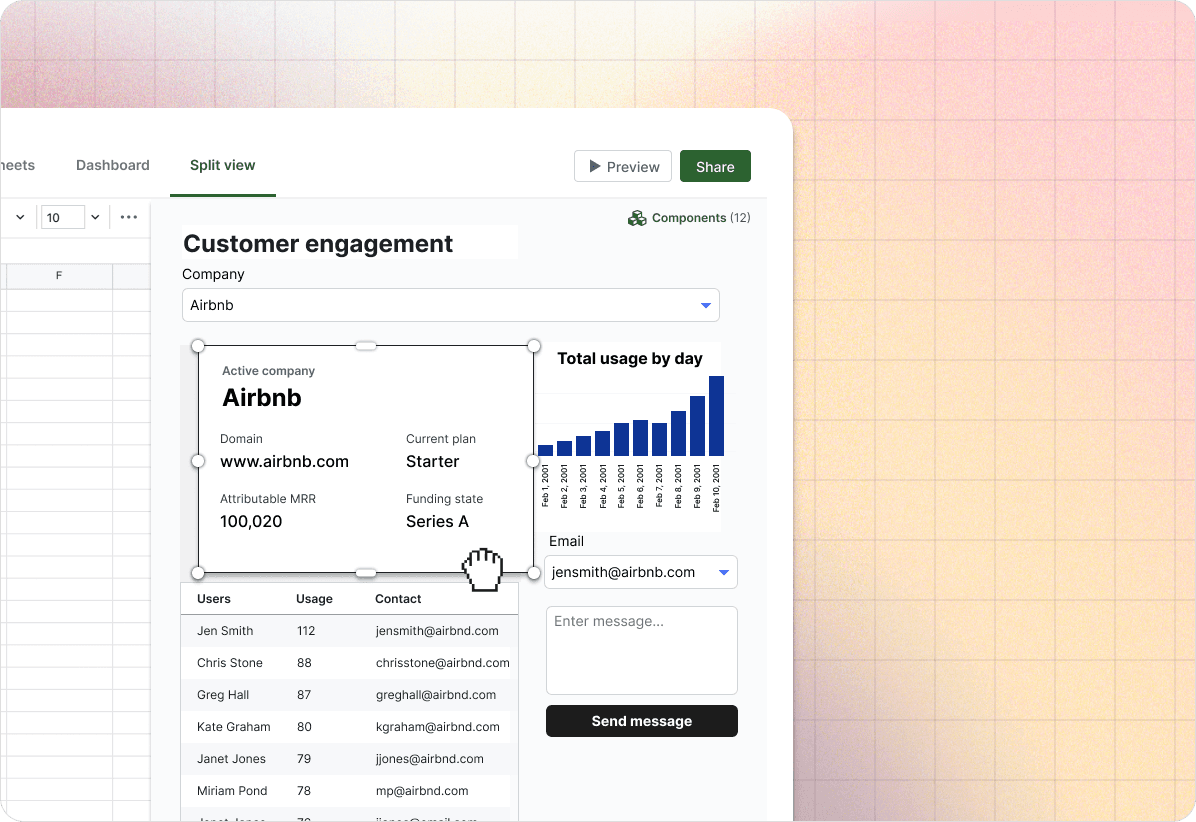
We focused a lot of energy and resources on the dashboard builder experience while I was there. The idea was that this would serve as the place where users would build shareable applications and where they triggered workflow automation. The team pivoted away from this emphasis after I left. There were significant eng hurdles involved, and it wasn’t the product differentiator we had imagined.

Dashboards
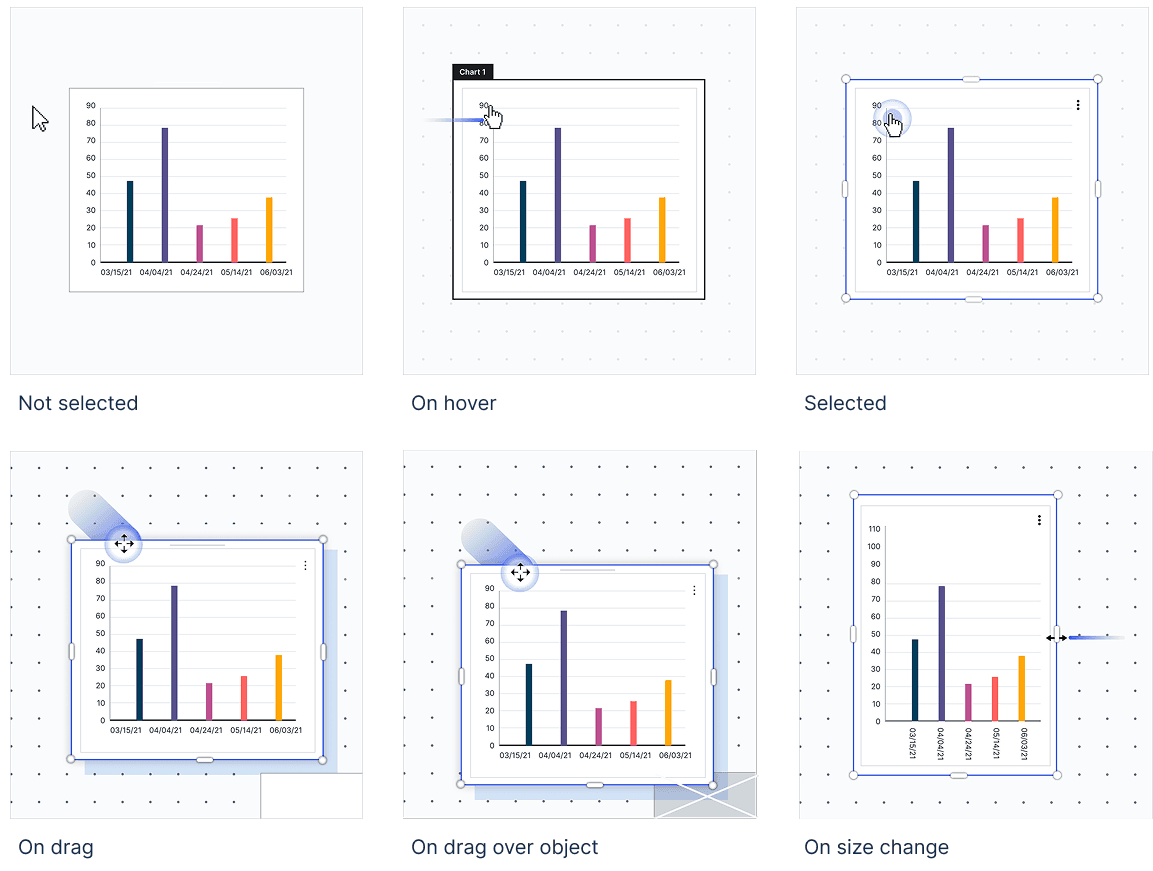
Users could pick from a range of components and dynamically bind those to objects in the spreadsheet.
Dashboards
Users could pick from a range of components and dynamically bind those to objects in the spreadsheet.
Dashboards
Users could pick from a range of components and dynamically bind those to objects in the spreadsheet.
Learnings from dashboards used as applications
It is expensive to engineer and maintain dashboard infrastructure.
Too many customization controls make it slower to create and edit dashboards.
Open canvas design with absolute positioned objects (that the team prioritized early on) introduces UX problems. Not responsive to changing screen sizes, not aligned with modern mobile-first approaches.
Specific components, like charts, are illegible when scaled too small.
Learnings from dashboards used as applications
It is expensive to engineer and maintain dashboard infrastructure.
Too many customization controls make it slower to create and edit dashboards.
Open canvas design with absolute positioned objects (that the team prioritized early on) introduces UX problems. Not responsive to changing screen sizes, not aligned with modern mobile-first approaches.
Specific components, like charts, are illegible when scaled too small.
Learnings from dashboards used as applications
It is expensive to engineer and maintain dashboard infrastructure.
Too many customization controls make it slower to create and edit dashboards.
Open canvas design with absolute positioned objects (that the team prioritized early on) introduces UX problems. Not responsive to changing screen sizes, not aligned with modern mobile-first approaches.
Specific components, like charts, are illegible when scaled too small.


The impact
Over 14 months, I helped scale Lido from a rough early MVP into a mature early-stage product. The team doubled in size during my tenure, growing from 5 to 10, and we secured a $5M funding round that validated the product direction and user experience work.
I established a strong design process and culture, delivered a production-ready design system in code and Figma, and provided detailed specifications that shaped the product's ongoing roadmap.
The impact
Over 14 months, I helped scale Lido from a rough early MVP into a mature early-stage product. The team doubled in size during my tenure, growing from 5 to 10, and we secured a $5M funding round that validated the product direction and user experience work.
I established a strong design process and culture, delivered a production-ready design system in code and Figma, and provided detailed specifications that shaped the product's ongoing roadmap.
The impact
Over 14 months, I helped scale Lido from a rough early MVP into a mature early-stage product. The team doubled in size during my tenure, growing from 5 to 10, and we secured a $5M funding round that validated the product direction and user experience work.
I established a strong design process and culture, delivered a production-ready design system in code and Figma, and provided detailed specifications that shaped the product's ongoing roadmap.
▲
2× team growth
2× team growth
2× team growth
during my tenure
▲
$5M funding
$5M funding
$5M funding
raised in refresh round
▲
Design system rolled out
enabled consistent UI and rapid iteration